



Smoking - the tuxedo - the full story!
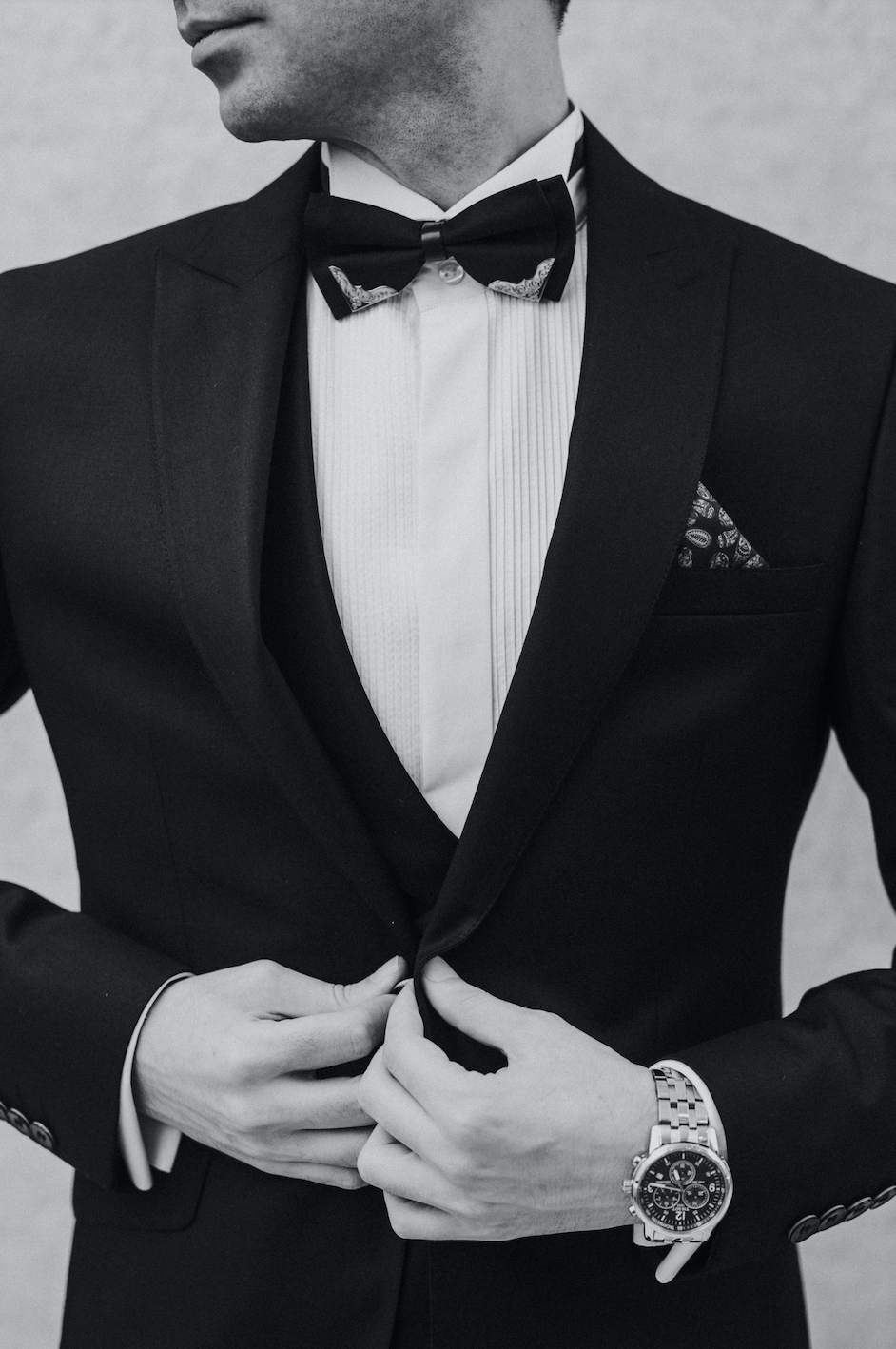
Smoking - Black Tie

- JACKET
- silk on lapels (lapel = a large fold on each side down the chest)
- silk-covered buttons, including the small suit buttons on the sleeves
- silk-pocket edging (sewn-in 'fold' in English: piping)
- TROUSERS
- Braids - silk ribbons along the legs from hip to floor
- silk waistband - at the waist where the trousers close
Colors
The tuxedo color is traditionally black, in use. Dark blue, gray, burgundy, dark green & purple have crept into the color palette. Most people recognize the velvet tuxedo jacket in precisely these shades,
History of the tuxedo
The creation of the tuxedo can be attributed to Edward VII (then Prince of Wales) and Savile Row tailor Henry Poole & co., which still exists today. The Prince requested attire that was more formal than an ordinary suit but less formal than a dress suit. The idea was for the Prince to have an outfit suitable for both informal and formal settings, and thus what is called a "dinner jacket" in England came into being.
Later, the Prince was introduced to the American millionaire James Brown Potter, who was visiting Great Britain. Edward VII arranged for James Potter to visit the Prince's tailor and get a "dinner jacket". Potter then wore his new outfit to an autumn ball in Tuxedo Park, after which it was named Tuxedo in America.
But why do we call it a 'smoking' here at home?
We do so because one of Edward VII's favorite jackets was his smoking jacket. The smoking jacket was an elegant jacket made of thick velvet that men wore over their party attire when they went to adjacent rooms to enjoy a strong alcoholic drink, discuss world affairs, and not least, smoke. They did this because the smoking jacket would absorb the smoke so their fine party clothes wouldn't smell of smoke. Washing clothes was not as frequent as it is today. But Edward VII was so fond of his smoking jacket that he asked Henry Poole to take inspiration from it when tailoring the Prince's 'dinner jacket'.
The difference between a tuxedo and a suit
The Jacket
The tuxedo jacket differs in 4 ways.
The lapel of a tuxedo will always be either a peaked lapel or a shawl lapel, which will have a satin finish. On a traditional suit jacket, you will mostly find a notch lapel and sometimes a peaked lapel. But the lapel will never have the characteristic satin surface.
The buttons on a tuxedo jacket will also have a satin surface on both the sleeve and front buttons. The tuxedo jacket will always be single-breasted with one button to close it. On an ordinary jacket, the buttons will never have a satin surface, and there are several different ways to close the jacket, the most common being single-breasted with two buttons.
The sleek silhouette of a tuxedo is also a noticeable distinction from a suit, and the way the tuxedo achieves this is by removing the flaps from the pockets. A traditional suit will also have two vents at the back, but a tuxedo will often have no vents at all; in some cases, a tuxedo may have a single vent.
You will also find that the sleeves of your tuxedo will be slightly shorter than those of your suits. This is due to the custom of wearing cufflinks with a tuxedo, and with shorter sleeves, there is a greater chance that the cufflinks will be shown off properly.
Note: A tuxedo should always be black, however, it is often seen in midnight blue, burgundy, or white; these variations are best suited for more informal/festive events such as New Year's Eve or a wedding.
The Trousers
The most noticeable difference when looking at a pair of tuxedo trousers will undoubtedly be the silk braid covering the seams on the outside of both trouser legs, so the trousers match the jacket's silk details. You will also never find belt loops on a pair of tuxedo trousers, simply because you should never wear a belt with your tuxedo. Instead, you could choose a pair of suspenders or side adjusters. It should also be mentioned that tuxedo trousers will usually be black, regardless of the jacket's color. (Exceptions may occur)
The Vest
You can also wear a vest with your tuxedo; this is not something you see very often, which makes it a great way to stand out at a black-tie event. However, it's not just any black vest; the tuxedo vest will have the same satin-covered buttons as the jacket, and it will usually have a very deep and rounded neckline, so it doesn't cover the details of the tuxedo shirt, instead of the usual V-neckline seen on regular vests.
Accessories
The Shirt: The classic tuxedo shirt will have a pleated or marcella front and studs (removable buttons) instead of regular shirt buttons. If you want a more modern and clean look, you can choose a concealed placket so the buttons are completely hidden. The shirt should also preferably have a regular collar, although there is an exception if the tuxedo is to be used for a very formal event, in which case a wing collar can be used (which otherwise belongs with white tie). Last but not least, the shirt should have double/French cuffs.
Bow Tie: The most striking characteristic of the tuxedo is its faithful partner, the bow tie. The bow tie will most often be made of black silk, but can also be found in fabrics such as velvet and in colors such as midnight blue or burgundy.
Cummerbund: A cummerbund is a wide piece of silk or satin fabric worn around the waist. The sole purpose of a cummerbund is to cover the lower part of the shirt and the trouser waistband, as well as any extra fabric that slightly hangs over the trouser waistband. In this way, a cummerbund makes one appear far more elegant.
Suspenders: Since you should never wear a belt with a tuxedo, suspenders are the only way to keep your trousers up if they can't stay up on their own (which they certainly should). But even if the trousers fit perfectly, you can still wear a pair of suspenders as they go incredibly well with a tuxedo, though only in white or black. (And yes, suspenders and a cummerbund can be worn together).
Pocket Square: When wearing a tuxedo, you should always choose a plain white pocket square, folded as a presidential square.
Cufflinks: As previously mentioned, the shirt should always have double/French cuffs, which means you will also need a set of cufflinks. Normally, cufflinks are a brilliant way to express some of your personality if you find your suit too boring. However, this does not apply when wearing a tuxedo, because your studs and cufflinks must always match, so the black onyx button is the safest choice.
Concluding remarks
After reading this guide, you as a reader should have become acquainted with the rules for wearing a tuxedo and be able to distinguish between a tuxedo and a suit. But nowadays, the rules have rather become a kind of guideline one can follow if in doubt, rather than being the undisputed law it was in the old days. At any red carpet event today, celebrities and their designers break every rule laid out in this article, so you are, of course, welcome to do the same next time you wear your tuxedo to a wedding or New Year's Eve. However, if you are going to a party with royalty where the invitation says 'Black Tie', we advise you to stick to the script and not try to be too challenging.